Risk Methodology
A transparent, auditable, and regulator-aligned approach to AML/CFT risk assessment
Overview
This page describes the risk methodology applied within the AML PROOF platform.
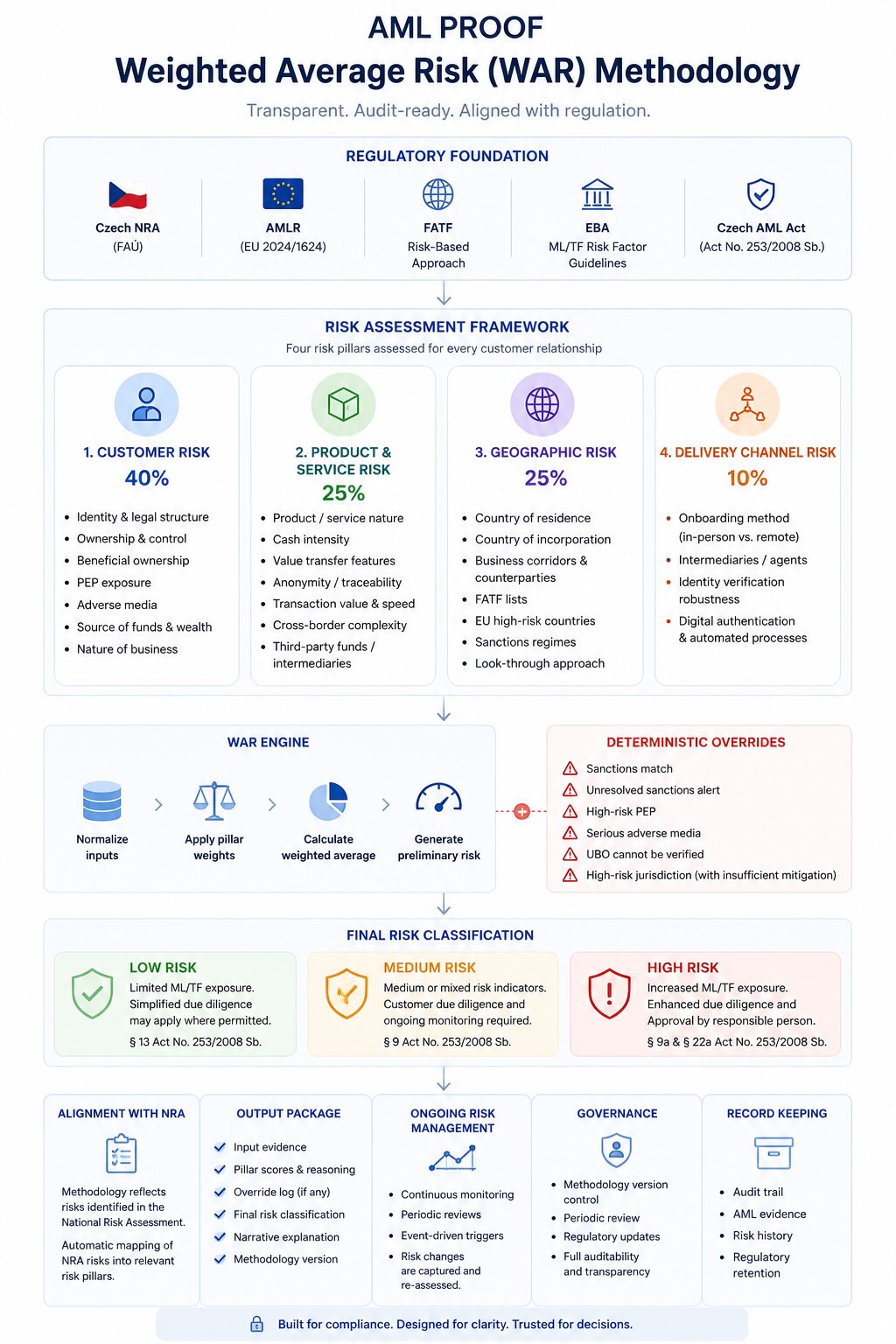
The methodology reflects a Weighted Average Risk (WAR) model designed in accordance with:
- National Risk Assessment (NRA) issued by the FIU
- EU Anti-Money Laundering Regulation (AMLR 2024/1624)
- FATF Risk-Based Approach
- EBA Guidelines on ML/TF risk factors
The methodology supports — but does not replace — professional judgment exercised by the obliged entity's AML Responsible Officer.
All assessments generated by AML PROOF are:
- transparent,
- reproducible,
- auditable,
- and suitable for supervisory review.
Risk-Based Approach
AML PROOF applies a Risk-Based Approach (RBA) fully in line with the NRA, Czech and EU AML regulations, as well as international standards.
Each client relationship is assessed using verified information and contextual risk indicators, resulting in a clear classification of LOW, MEDIUM, or HIGH ML/TF risk, accompanied by a documented rationale.
The objective is proportionate compliance, not mechanical scoring.
Risk Assessment Framework
The risk assessment framework evaluates four core risk pillars, each reflecting a distinct dimension of ML/TF exposure.
1. Customer Risk (40%)
40%Assessment focuses on: identity and legal form, ownership and control structure, beneficial ownership transparency, exposure to politically exposed persons (PEPs), adverse media signals, credibility of declared source of funds and source of wealth, nature of business or activity.
2. Product & Service Risk (25%)
25%Assessment focuses on: nature of the product or service provided, cash intensity and value transfer characteristics, anonymity or traceability features, transaction value and velocity, cross-border complexity, involvement of third-party funds or intermediaries.
3. Geographic Risk (25%)
25%Assessment considers: countries of residence, establishment, and operation, transaction corridors and counterparties, exposure to jurisdictions identified by FATF, the European Union, sanctions regimes and other authoritative sources. Geographic risk is evaluated using a look-through approach, considering all relevant jurisdictions connected to the relationship.
4. Delivery Channel Risk (10%)
10%Assessment focuses on: onboarding method (face-to-face vs remote), use of intermediaries or agents, robustness of identity verification and authentication controls, reliance on digital or automated processes.
Risk Classification
Risk outcomes are classified into three categories to enable proportionate AML/CFT measures.
LOW RISK
Relationships with limited ML/TF exposure, transparent ownership, predictable behavior, and low-risk contextual factors. Simplified due diligence may be applied where permitted by law.
MEDIUM RISK
Relationships with moderate or mixed risk indicators requiring standard due diligence and ongoing monitoring.
HIGH RISK
Relationships presenting elevated ML/TF exposure requiring enhanced client identification and due diligence and the consent of the compliance officer (Art. 9 AMLR) under the AMLR (Art. 20–28 AMLR).
Deterministic Overrides
Certain conditions override the weighted assessment logic and automatically determine the final risk outcome.
Deterministic overrides operate outside the WAR calculation and take precedence where legally or prudentially required.
Examples include:
- confirmed matches to applicable financial sanctions,
- unresolved sanctions screening alerts,
- high-risk PEP exposure,
- current and credible adverse media indicating financial crime,
- inability to identify or verify beneficial ownership,
- legally defined high-risk jurisdictions combined with insufficient mitigating controls.
Overrides ensure that critical risks are never diluted by averaging.
Alignment with National Risk Assessment (NRA)
How the methodology reflects the National Risk Assessment of Money Laundering.
By law, obliged entities must incorporate risks identified in the NRA into their own risk assessments. Our WAR model automatically addresses these risks across relevant pillars.
| Risk Factor | NRA Category | Methodology Coverage |
|---|---|---|
| Suspicious links between transaction participants | NRA Annex 2 — 13% of all suspicious transaction reports | Customer risk assessment — PEP exposure, adverse media from publicly available sources |
| Abuse of high cash-turnover business sectors | NRA Annex 1 — cash flows | Product risk assessment — cash intensity; automatic score increase for real estate, casino and similar sectors |
| Abuse of the one-off nature of real estate transactions | NRA Annex 1 — real estate transactions | Product risk assessment — minimum MEDIUM risk threshold for all real estate transactions (NRA Annex No. 1 — inherent sector risk) |
| Abuse of sub-threshold transactions — deliberate payment splitting | NRA Annex 1 — all 4 risk models | Payment structuring detection module — ongoing monitoring of the business relationship (Art. 20–28 AMLR) |
| Abuse of a third party's bank account | NRA Annex 2 — 10% of all suspicious transaction reports | Product risk assessment — third-party funds and pooled accounts |
| Transfer of proceeds abroad, cross-border chains | NRA Annex 2 — risk model 4 | Geographic risk assessment — corridor multiplier, FATF Black List, EU sanctions lists |
| Abuse of non-face-to-face identification methods | NRA Annex 1 — circumvention of identification process | Delivery channel risk assessment — in-person vs. remote vs. via intermediary |
| Concealment of the actual ownership and management structure of a legal entity | NRA Annex 1 — circumvention of identification | Customer risk assessment — ownership transparency, beneficial owner (Art. 20–28 AMLR) |
| Abuse of virtual assets — unhosted wallets, P2P transactions | NRA Annex 1 — virtual assets | Product risk assessment — unmitigated transfers to unhosted wallets, unregulated virtual asset service provider |
This table shows only mapping examples. The full WAR model incorporates dozens of indicators aligned with the NRA report.
Risk Scoring Logic
Risk scoring within AML PROOF serves to:
- structure analysis,
- support consistency,
- enable auditability.
It does not replace expert judgment and does not function as a standalone decision engine.
Numeric values are used internally to support classification, while final decisions remain categorical and reasoned.
Weighted Average Risk (WAR)
AML PROOF applies a Weighted Average Risk (WAR) model to aggregate risk indicators across the four pillars.
The WAR model:
- operates on an internal normalized scale,
- prioritizes consistency and explainability over numeric precision,
- supports proportional classification into LOW, MEDIUM, or HIGH risk.
The WAR score is not an absolute metric and is not intended for comparison across clients or institutions.
Outputs & Reporting
For every assessment, AML PROOF generates a regulator-ready risk record, including:
- documented input data,
- pillar-level risk reasoning,
- applied overrides (if any),
- final risk classification,
- narrative justification,
- list and methodology versions used.
All outputs are designed to withstand supervisory and audit scrutiny.
Risk Assessment in Compliance with Professional Chamber Requirements
AML PROOF continuously incorporates the specific requirements and guidelines of the relevant professional chambers into its weighted risk assessment system. Under the AMLR framework (Art. 10 AMLR), these chambers are required to identify and assess ML/TF risks applicable to their members' activities and make this assessment available to them.





Ongoing Risk Management
Risk assessments are not static.
AML PROOF supports continuous risk management through:
Ongoing Monitoring
Detection of changes in behavior, exposure, or external risk signals.
Periodic Reviews
Scheduled reassessment based on the assigned risk level.
Trigger Events
Immediate reassessment upon material changes such as: ownership updates, new adverse findings, regulatory or sanctions updates.
Governance & Controls
The risk methodology is governed through:
Version Control
All changes are versioned, documented, and traceable.
Periodic Review
Methodology is reviewed regularly to reflect regulatory developments and emerging risks.
Regulatory Responsiveness
Updates are applied following changes to EU law, FATF guidance, or sanctions regimes.
Auditability
Every assessment can be reproduced using stored inputs and the applicable methodology version.
Documentation & Record Retention
AML PROOF ensures:
- full audit trails for all assessments,
- evidence of compliance with AML/CFT obligations,
- historical tracking of risk profile changes,
- record retention in line with regulatory requirements.
Why It Matters
This methodology provides obliged entities with:
Clarity
Simple LOW / MEDIUM / HIGH outputs with plain-language reasoning
Compliance
Aligned with FATF/EU standards and accepted by regulators
Credibility
Auditable, transparent, and defensible in supervisory reviews
Efficiency
Minimal operational burden while maintaining 100% compliance
AML PROOF ensures that every risk assessment is simple for users, robust for compliance, and credible for regulators.
Methodology Status: Active
Methodology Version: v1.5
Last Updated: 2025-01-09
Governing Document: AML PROOF Weighted Average Risk (WAR) Methodology – Compliance Annex
Notice on the Nature of Outputs
Risk assessments generated by the AML PROOF platform are supportive and informational in nature. They serve to structure analysis and ensure auditability, not as a standalone decision-making mechanism. The final responsibility for assessing a client, approving a business relationship, or rejecting a transaction always fully lies with the designated Designated Person of the obliged entity.
Notice on External Data Sources
Risk assessments include information originating from third-party databases and data sources (including sanctions lists, PEP databases, and adverse media sources). AML Proof s.r.o. does not participate in the creation of these sources and does not assume responsibility for their completeness, accuracy, or timeliness. Content may contain factual inaccuracies or technical errors. The user is obliged to critically evaluate this data in the context of the specific business case.
Notice on Methodology Version
The risk methodology is continuously updated in line with developments in the regulatory environment. Each assessment is tied to the version of the methodology in effect at the time it was performed. AML Proof s.r.o. reserves the right to modify the methodology; changes do not retroactively affect assessments that have already been performed and stored.
The proprietary Weighted Average Risk (WAR) risk model has an informative character and is intended for the responsible Designated Person of the obliged entity. However, the final responsibility for approving or rejecting clients/transactions always fully lies with the responsible Designated Person of the obliged entity.
Register your obliged entity
Registration is simple — just a few clicks, and it's free.
Starter plan at no cost. No credit card required.